Saffron is often described as the most expensive spice in the world. Sometimes referred to as red gold, this precious seasoning has been treasured for thousands of years, not only for its distinctive flavour and beautiful golden colour but also for the extraordinary amount of work required to produce it. A small quantity can cost more than many other spices many times its weight. But what makes saffron so valuable, where does it come from, and how is it produced? Saffron comes from the flower of the Crocus sativus, commonly known as the saffron crocus. Although its precise origins are debated, it has a long history in ancient Persia, present-day Iran, where it was cultivated and used in cooking, medicine, perfumes and dyes. Today, Iran remains the world’s largest producer of saffron, although it is also grown in countries such as Afghanistan, India, Spain, Greece and Morocco.
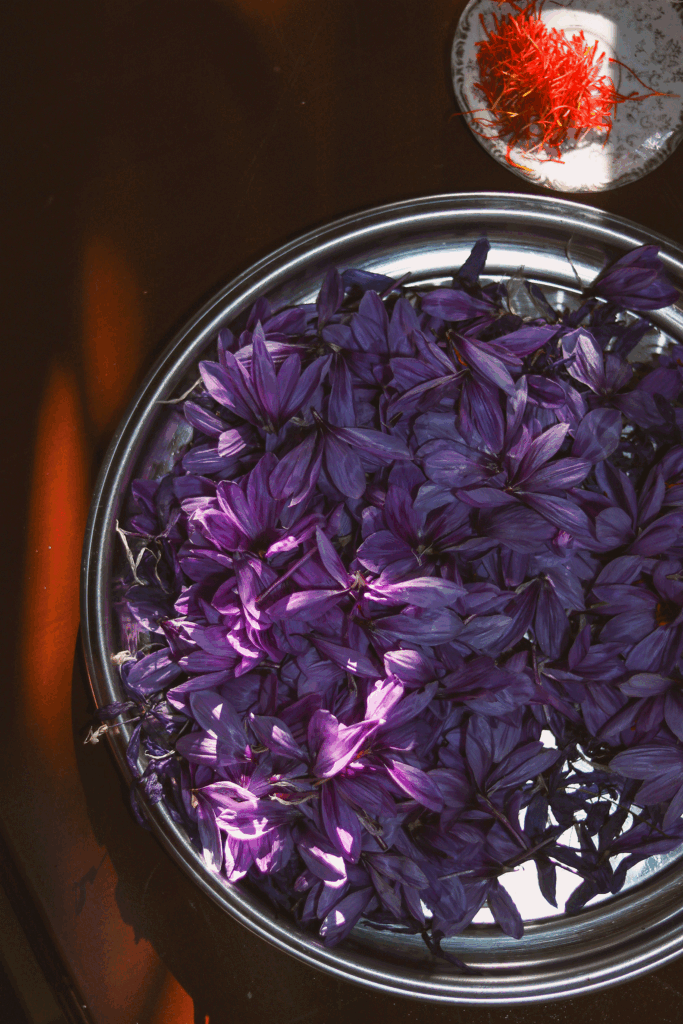
The saffron crocus is a beautiful purple flower which usually blooms in the autumn. Unlike most crops, saffron is not harvested for its leaves, roots or petals, but for the three tiny red threads, known as stigmas, found inside each flower. These delicate threads are the valuable part of the plant and are responsible for distinctive aroma of the saffron, flavour and rich golden-yellow colour. Growing saffron requires patience and careful attention. The bulbs, more accurately called corms, are planted in well-drained soil, usually during the summer months. The plants need plenty of sunshine and relatively dry conditions, although they also require sufficient moisture during their growing season. Once established, the flowers emerge in autumn, often for only a few weeks. The harvesting process is particularly demanding. The flowers must be picked by hand, usually early in the morning before the sun becomes too strong and the delicate flowers begin to wilt. Each flower must then be carefully opened, and its three red stigmas removed by hand. These tiny threads are subsequently dried to preserve their colour, aroma and flavour.
It is this painstaking process which explains the extraordinary price of the saffron. Approximately 150,000 to 200,000 flowers may be required to produce just one kilogram of dried saffron. Think about the enormous amount of time and labour involved in picking so many flowers and separating the tiny threads. There is no easy way to mechanise this delicate work without risking damage to the valuable stigmas. Consequently, saffron can sell for thousands of pounds per kilogram, depending on its quality and origin.
Saffron is a remarkable example of something whose value is determined not simply by its size, but by the effort and care required to produce it. A few tiny threads can bring colour, fragrance and flavour to an entire meal. There is, however, something far more precious than saffron, something whose value cannot be measured in money. It is the salvation of our souls. The Bible tells us that our salvation came at an immeasurable cost. God did not purchase our redemption with gold, silver or precious stones. The price was the life of His beloved Son, the Lord Jesus Christ. 1 Peter 1:18–19 reminds us: “Ye were not redeemed with corruptible things, as silver and gold … But with the precious blood of Christ, as of a lamb without blemish and without spot.”
Think about the cost involved in producing saffron. Thousands upon thousands of flowers must be gathered to obtain a single kilogram of this precious spice. Yet the cost of our salvation was infinitely greater. God gave His only begotten Son to die upon the cross, bearing the punishment for our sin so that we might be forgiven and receive eternal life. Saffron may be called red gold, but even the most expensive spice in the world cannot compare with the cost of salvation. That price has already been paid. The apostle Paul in Romans 6:23 tells us, “the gift of God is eternal life through Jesus Christ our Lord.” The price was high, but for you and I salvation is God’s free gift.
What value do you place upon your soul? Have you personally received the gift that cost God so much to give?
P. Pilgrim pilgrimway101@yahoo.com