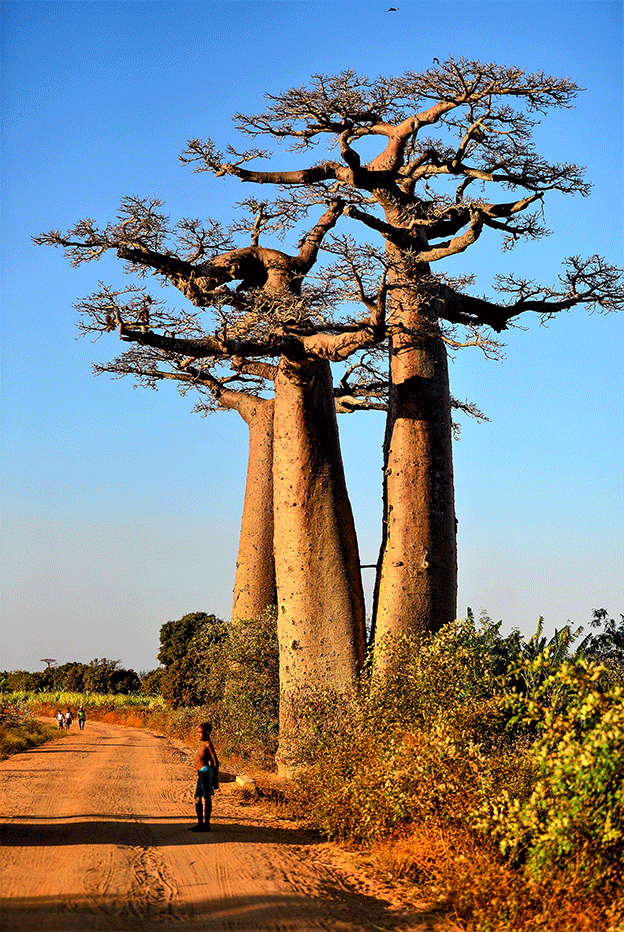
Across the vast plains and dry landscapes of central and southern Africa stands one of the most remarkable trees in the world: the baobab tree, it belongs to the genus Adansonia. With its enormous trunk, thick branches and extraordinary ability to survive in harsh conditions, it has become known as the “Tree of Life.” Unlike many trees, which have relatively narrow trunks, the baobab can store large quantities of water in its fibrous tissues. This helps it survive long periods of drought in regions where rainfall is unreliable. Some species can live for thousands of years, although the ages of individual trees can be difficult to establish accurately. Its distinctive appearance has earned it the nickname of the “upside-down tree,” because its bare branches can resemble roots reaching into the sky. Interestingly, almost every part of the tree can be useful. Its fruit contains vitamin C and other nutrients. The leaves can be eaten as a vegetable, and the seeds can be used for food or oil. In some communities, the bark provides fibres for making rope and other materials. The tree also offers shade and shelter to people and animals. Therefore, for generations, African communities have depended upon this tree for food, water, shelter and medicine. Its ability to endure drought and provide so much for people has made it a powerful symbol of life and survival. These remarkable qualities explain why the baobab is called the Tree of Life. It provides nourishment, resources and protection in an environment where these things may be difficult to find. Its long life and ability to survive challenging conditions have made it a symbol of endurance and generosity.
Yet, as wonderful as this tree is, it cannot give eternal life. It does however remind us of the goodness of God’s creation, and directs us towards the Creator Himself. While the baobab tree sustains physical life on earth, the ‘Tree of Life’ in Scripture points us towards God’s provision of life, His eternal purposes and the everlasting blessings He promises to His people.
The first mention of the Tree of Life in the Bible is found in Genesis. When God created Adam and Eve, He placed them in the Garden of Eden, where they enjoyed fellowship with Him. Genesis 2:9 tells us: “And out of the ground made the LORD God to grow every tree that is pleasant to the sight, and good for food; the tree of life also in the midst of the garden, and the tree of knowledge of good and evil.” The Tree of Life was part of God’s provision in the garden. However, Adam and Eve disobeyed God’s command and brought sin into the world. Consequently, they were driven out of Eden, and access to the Tree of Life was guarded (Genesis 3:22–24).
This account reminds us that sin separates mankind from God. The physical provisions of this world, however wonderful, cannot remove our sin or restore our broken relationship with our Creator. We need something greater than earthly nourishment: we need spiritual life. The Bible teaches that eternal life is God’s gift through His Son, Jesus Christ. John 3:16 declares: “For God so loved the world, that he gave his only begotten Son, that whosoever believeth in him should not perish, but have everlasting life.” The baobab tree can sustain the body, but Jesus Christ gives everlasting life to those who believe in Him. He died upon the cross for our sins and rose again, making the way for sinners to be reconciled to God. Jesus said in John 11:25 “I am the resurrection, and the life: he that believeth in me, though he were dead, yet shall he live:” This is the greatest hope offered to mankind. The baobab tree may nourish the body for a time, but only Christ can give eternal life.
Let us therefore appreciate the wonders of God’s creation while remembering that the greatest gift is not simply a long earthly life, but everlasting life through the Lord Jesus Christ.
P. Pilgrim pilgrimway101@yahoo.com