P. Pilgrim
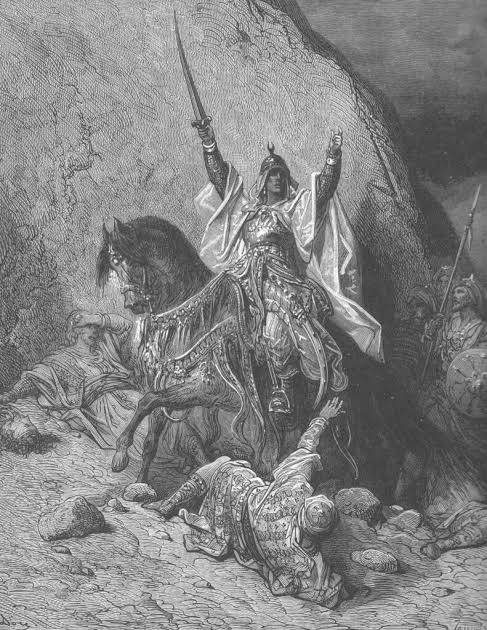
Saladin, whose full name was Salah ad-Din Yusuf ibn Ayyub, was one of the most famous leaders of the medieval world. A Kurdish Muslim, he rose from relatively humble beginnings to become Sultan of Egypt and Syria and the founder of the Ayyubid dynasty. He became particularly famous during the Crusades and for his victory over the Crusader army at the Battle of Hattin in 1187. Shortly afterwards, he recaptured Jerusalem, a city that had been under Crusader control for almost ninety years. Saladin was a powerful ruler. He commanded armies, conquered cities, controlled enormous territories and possessed access to great wealth. His name became known throughout the Middle East and Europe. Yet the story of his death presents a remarkable contrast to the greatness he had achieved. Saladin died in Damascus on 4 March 1193, after suffering a fever. He was about fifty-five years old. When his possessions were examined after his death, it was discovered that he had very little personal wealth. Historical accounts say that his treasury contained only one gold piece and a small amount of silver. His great wealth had been distributed among the poor, soldiers, officials and others to whom he had given generously. There was reportedly not even enough money left to pay all the expenses of his funeral. This explains why Saladin died, in the material sense, “penniless”. It was not because he had never possessed wealth. He had controlled enormous resources. Rather, he had given much of what he possessed away. The man who had conquered cities and commanded armies could not take even his accumulated wealth with him into the grave.
There is a famous story associated with his death. A shroud was said to have been carried through the streets as a banner, with a proclamation reminding the people of the great ruler who had died. One traditional version records the words: “This is all that remains of the mighty Saladin, the conqueror of nations.” The precise historical details of this story are debated; some older accounts give slightly different wording, and one modern biography notes that the famous procession is not confirmed by the Arabic records. (Library of Congress Tile) Nevertheless, the picture communicates a profound truth: a man may conquer nations, possess riches and become famous throughout the world, but eventually he must leave everything behind.
The Bible teaches the same truth. Job said: “Naked came I out of my mother’s womb, and naked shall I return thither,” Job 1:21. No matter how much a person earns, builds or possesses, there comes a day when none of it can accompany him beyond the grave. A house cannot follow us. Money cannot follow us. Titles cannot follow us. Fame cannot follow us. Even the greatest achievements of this earthly life remain behind. Jesus Christ during his ministry asked a searching question in Mark 8 verse 36: “For what shall it profit a man, if he shall gain the whole world, and lose his own soul?” These words should cause every one of us to stop and think. Saladin gained tremendous earthly power, but death eventually brought him to the same place as every other human being. The conqueror and the common man must both face the grave. The lesson is not that work, achievement or possessions are worthless. Rather, we must remember that they are temporary. The most important question is not “What will I possess?” but “What will I have when this life is over?” The Apostle Paul reminds us: “For we brought nothing into this world, and it is certain we can carry nothing out”, in 1 Timothy 6:7. Saladin’s story therefore leaves us with a solemn reminder. The conqueror of nations could conquer cities, defeat armies and gather wealth, but he could not conquer death. When his earthly journey ended, all his possessions remained behind. One day, every one of us will stand at eternity’s door. The things we worked so hard to obtain will stay on this earth. What matters eternally is our relationship with God and the condition of our soul. We may leave a great name behind, but we cannot take earthly treasures with us. Therefore, we should live not merely for time, but for eternity.
(pilgrimway101@yahoo.com)