
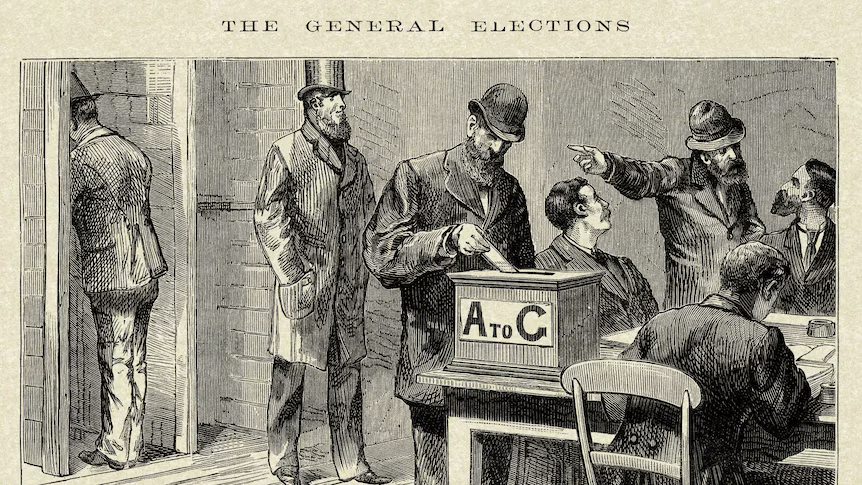
According to the dictionary, an election is a formal group decision-making process in which part or all of a population participates by voting to select one or more individuals for public office or another position of responsibility. These voters have a free and genuine choice between at least two or more candidates.
The earliest documented popular elections for public officials, in which all citizens were eligible to vote and hold office, can be traced to the election of the Ephors in Sparta in 754 BC in ancient Greece. These elections were conducted under the mixed government structure of the Spartan Constitution, utilising a multiple-winner plurality system and voice voting. Elections continued being utilised as a method of decision-making in ancient Greece and Rome, continuing through the Medieval period. In the Asian continent the Pala King Gopala who ruled from 750s – 770s AD in early medieval Bengal was elected by a group of feudal chieftains. Such elections were quite common in contemporary societies of the region. In the Chola Empire, around 920 AD, in Uthiramerur which is in present-day Tamil Nadu India, palm leaves were used for selecting the village committee members. The leaves, with candidate names written on them, were put inside a mud pot. To select the committee members, a young boy was asked to take out as many leaves as the number of positions available. This was known as the Kudavolai system.
Though the modern day process which will occur on Friday 5th March across Nepal has its origins of elections in the contemporary world with the gradual emergence of representative government in Europe and North America beginning in the 17th century. At that time, the holistic notion of representation characteristic of the Middle Ages was transformed into a more individualistic conception, one that made the individual the critical unit to be counted. For example, the British Parliament was no longer seen as representing estates, corporations, and vested interests but was rather perceived as standing for actual human beings. The movement abolished the so-called “rotten boroughs”, that was electoral districts of small population controlled by a single person or family, and culminated in the Reform Act of 1832. It was a direct consequence of this individualistic conception of representation. Today the consensus is that governments derive their authority to govern from the consent of the populace and are responsible for serving the interests of all citizens.
The bible has much to say about those who receive this authority to rule. What should be their conduct in office and how they should protect vulnerable. They are to rule justly over men, not regarding status nor wealth. They are voted by the people for all the people, to build up the nation in truth and honesty. The Bible also exhorts the people to pray for those whom God has raised up to rule. The new testament book of 1Timothy chapter 2 verse 2 says pray ‘for kings, and for all that are in authority; that we may lead a quiet and peaceable life in all godliness and honesty.’ Citizens are required by God to pray so that they can live lives characterized by freedom and liberty. So therefore, we should pray for those in authority and power that they will fear God, act respectively and prioritize the nation’s best interests.
P. Pilgrim pilgrimway101@yahoo.com