
Spandan Bhattarai
Thomas Alva Edison is regarded as one of the most influential inventors in modern history. His life story is not merely a record of inventions, but a powerful example of perseverance, learning from failure, and unwavering determination. By transforming scientific ideas into practical applications, he helped make everyday life easier for ordinary people, leaving a lasting impact on modern civilization.
Thomas Alva Edison was born on February 11, 1847, in the small town of Milan, Ohio, in the United States. His father, Samuel Edison, was politically active, and his mother, Nancy Edison, was a former teacher. He was the youngest of seven children, and his mother played a crucial role in shaping his early education.
From a young age, Edison was intensely curious. He constantly asked questions about how and why things worked. This curiosity sometimes led him into trouble. In one well-known childhood incident, he attempted an unusual experiment to understand why birds could fly, which ended up causing problems rather than answers. Yet such experiences only strengthened his desire to explore and learn.
Edison’s formal schooling was very limited. He attended a school in Port Huron, Michigan for only about three months. His teacher considered him inattentive and slow to learn, after which his mother withdrew him from school and began teaching him at home. This decision proved to be transformative. Studying at home allowed Edison to learn freely, nurturing his creativity and independent thinking.
He never attended college or university. Instead, he became a self-taught learner. He developed knowledge through reading scientific books, conducting experiments, and learning from experience. Spending long hours in libraries, exploring new ideas, and embracing failure became his way of education.
During his childhood, Edison also began to lose his hearing, a condition that continued throughout his life. Rather than seeing it as a disadvantage, he considered it beneficial, as it helped him concentrate more deeply on his work without distractions.
At the age of twelve, Edison began working to support his family. He sold newspapers and snacks on trains and even started publishing his own small newspaper. He also set up a miniature laboratory in a train carriage, where he conducted experiments. However, after a chemical accident caused a fire, he was removed from the train. Despite this setback, he did not abandon his passion for experimentation.
A major turning point in his life came when he saved a young boy from a train accident. In gratitude, the boy’s father taught him telegraphy. Edison then worked as a telegraph operator in various cities, gaining deep knowledge of electrical communication systems. This experience laid the foundation for his future innovations.
Edison’s journey as an inventor gradually accelerated. He developed improvements in communication devices, which brought him financial stability and allowed him to invest in further research. In 1876, he established a research laboratory in Menlo Park, New Jersey. This laboratory functioned like an invention factory, where teams worked together to create new technologies. It became a model for modern research institutions.
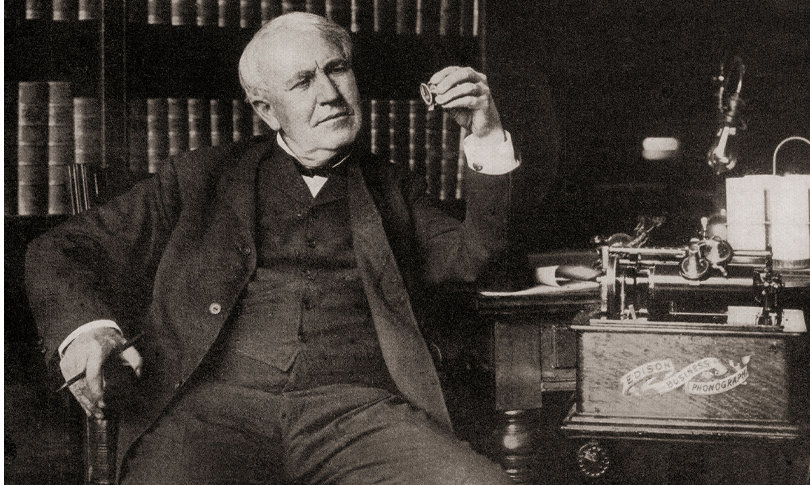
Among his most significant inventions were the phonograph, the practical electric light bulb, and motion picture devices. The development of the electric light bulb, in particular, revolutionized the world by bringing light into homes and cities. Beyond the bulb itself, Edison also developed systems for generating and distributing electricity, making widespread use possible.
Edison’s approach to work was unique. He was willing to experiment thousands of times to achieve success. While developing the light bulb, he tested numerous materials before finding one that worked effectively. He did not see failure as defeat, but as a learning process.
He lived during a time of rapid scientific and industrial change. Among his contemporaries was Alexander Graham Bell, who invented the telephone, and Nikola Tesla, who introduced new ideas in electrical systems. Edison’s rivalry with Tesla over electrical current systems became famously known as the “War of Currents,” a debate that significantly influenced the development of electrical technology.
Edison’s personal life also had its share of ups and downs. He was married twice and had six children. His intense dedication to work sometimes created challenges in his family life.
Throughout his lifetime, Edison obtained more than a thousand patents, an extraordinary achievement. He not only invented new devices but also ensured they were practical and accessible to the general public.
Even in his later years, he remained active, working on energy storage devices and other industrial innovations. He passed away on October 18, 1931.
In conclusion, the life of Thomas Alva Edison teaches an important lesson: success is not solely dependent on formal education, but on curiosity, hard work, and persistence. He demonstrated that failure is not the end, but an essential step toward achievement.
The modern world—illuminated by electric light, enriched by sound recording, and entertained by motion pictures—bears the deep imprint of Edison’s contributions. For this reason, he is remembered not only as an inventor, but as a visionary who helped shape the modern age.